Summary of Research Study
Older MS patients typically experience fewer relapses compared to younger patients. Research suggests this may, in part, be due to the immune system weakening with age, a process known as immunosenescence. This natural decline can make older patients more susceptible to adverse events from some disease modifying therapies (DMTs), including infections. Additionally, other medical conditions, such as heart disease, diabetes, and cancer, are more prevalent later in life and may increase the risk of DMT side effects, changing the risk-benefit profile of medications they may either be currently taking, or considering for their MS. Therefore, it is crucial to explore whether older patients can safely stop taking DMTs without increasing their risk of relapses or new brain lesions. The results were inconclusive and the researchers were unable to say whether patients who stopped DMTs did as well as those who continued. An extension study to gather more information is ongoing.
Who Did the Research?
This study was led by the University of Colorado and included participants from multiple study sites. The principal investigator was Dr. John Corboy, and the study was funded by PCORI and received additional support from the National Multiple Sclerosis Society and EMD Serono.
Who Was in the Study?
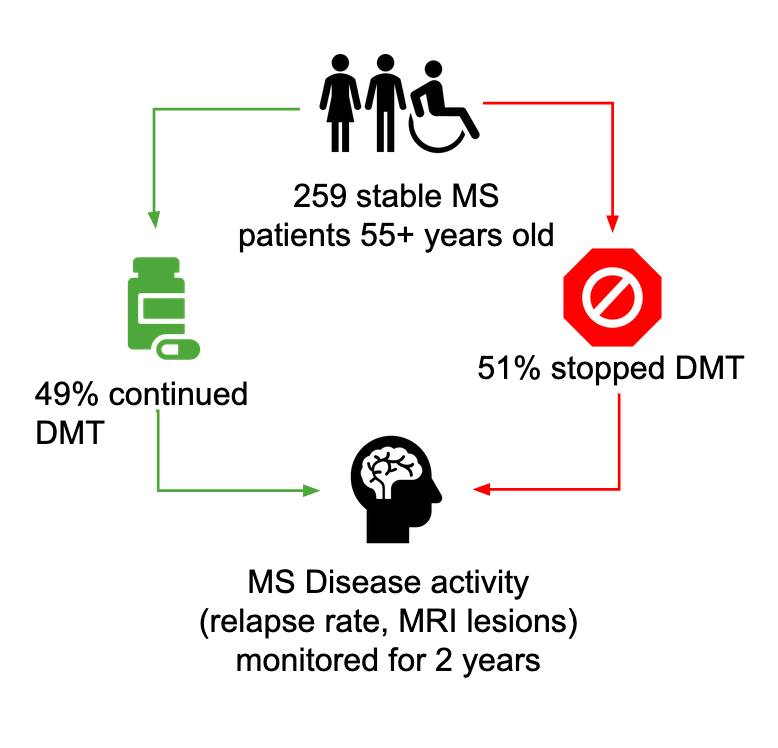
The study included 259 MS patients aged 55 and older who were taking DMTs. These patients had not experienced a relapse for at least five years or new brain lesions for at least three years. The average age of participants was 63, with 83% being women. Most participants were White (89%), followed by Black (9%) and other races (1%); 1% were Hispanic. All participants received care at one of 19 health systems in the United States.
Study Process
The research team conducted a study to determine if older patients who stopped taking DMTs had a higher risk of new relapses or new brain lesions compared to those who continued taking the medication. They also assessed whether stopping DMTs affected patients' level of disability. Participants were randomly assigned to either stop or continue taking their DMTs. They underwent MRI scans at the start of the study and at 6, 12, and 24 months to check for new or changing brain lesions. Additionally, participants had regular doctor visits and completed surveys about their symptoms every six months.
What Were the Results?
After two years, 5% of patients who continued taking DMTs had a relapse or new brain lesion, compared to 12% of those who stopped taking DMTs. The researchers were unable to say that stopping DMTs wasn’t worse than continuing DMTs in this group of patients. However, there was no significant difference in changes in the level of disability between the two groups.
Limitations of the Study
The study only included older patients with no recent relapses or brain lesions and a moderate ability to function. Therefore, results may differ for other groups of patients. About one-third of participants did not complete the full two-year study, which may have influenced the results.
Future Research
An extension study looking at results over 5 years is ongoing. These results are expected to help the researchers better understand the impact of discontinuing DMTs.
Technical Summary: Detailed Research Methods and Findings
Research Methods
Participants were randomly assigned to either stop or continue their DMTs. They underwent MRI scans at baseline and at 6, 12, and 24 months to detect new or expanding lesions. Participants also had regular clinical assessments and completed symptom surveys every six months. Input from MS patients, clinicians, patient advocates, and pharmaceutical company representatives was integrated throughout the study to ensure a comprehensive approach.
The study included a statistical non-inferiority test to determine whether discontinuing DMTs was not unacceptably worse than continuing DMTs. Researchers defined non-inferiority as a maximum difference of 8% in any relapse or new or expanding brain lesions on MRI in discontinuers compared to continuers. Specifically, researchers expected relapses or new or expanding brain lesions on MRI to occur in 2% of the continuer group and accepted a maximum of 10%, or a relative risk of 5.0, in the discontinuer group to be non-inferior.
Key Findings
The study's primary outcome measure was the presence of relapses or new brain lesions. At a mean follow-up of 22 months, 4.7% of patients who continued taking DMTs reported relapses or new brain lesions on MRI, compared with 12.2% of patients who discontinued DMTs. With a non-inferiority margin of 8%, the study was unable to demonstrate that discontinuing DMTs was non-inferior to continuing DMTs (difference in proportions of 7.5%; 95% confidence interval: 0.6%, 15.0%; p=0.521).The two groups did not differ significantly in confirmed disability progression.
Conclusion
These results fell into the non-inferiority margin “gray zone” and the researchers were unable to conclude that discontinuing DMTs is non-inferior to continuing. People who stop their DMT may have a slightly increased risk for MRI lesions and/or relapses.
Learn more about the implications of this research
Podcast
Excerpt from a RealTalkMS podcast interview with the study team. To listen the the full podcast click here.
Peer Reviewed Publications
"Risk of New Disease Activity in Patients with Multiple Sclerosis who Continue or Discontinue Disease-Modifying Therapies (DISCOMS): A Multicentre Randomised, Single-Line, Phase 4, Non-Inferiority Trial (2023)." The Lancet Neurology
"Perspectives of Patients with Multiple Sclerosis on the Discontinuation of Disease Modifying Therapies" Multiple Sclerosis Journal (not open access)
Other Media
Written interview with John Corboy for InfoMS. https://mscenter.org/article/results-of-the-disco-ms-study/
Video interview with John Corboy for MedPage Today. https://www.medpagetoday.com/meetingcoverage/cmscvideopearls/99574
Discussion with Dr. Robert Fox for Neurology Live.https://www.neurologylive.com/view/disco-ms-study-findings-clinical-experience
Webinar